Last updated: August 16, 2026
How much meat you get from half a cow comes down to two numbers most first-time buyers never hear explained: hanging weight and take-home weight. They are not the same figure, and the gap between them is exactly why a “300 pound half beef” doesn’t put 300 pounds of steaks and roasts in your freezer.
This guide walks through why hanging weight and boneless weight differ, roughly how a half share splits between steaks, roasts, and ground beef, how long that meat tends to last two people, and how much freezer space you actually need to plan for.
Quick Answer
How Much Meat Do You Get From Half a Cow?
- You’ll typically take home roughly 60 to 65 percent of the half’s hanging weight once it’s boned, trimmed, and packaged, not the hanging weight itself.
- The cuts split roughly into 40 percent ground beef, 20 percent steaks, 20 percent roasts, and the rest in stew meat, short ribs, and soup bones.
- Plan on about 1 cubic foot of chest freezer space for every 25 to 30 pounds of packaged, wrapped meat.
- Two people typically work through a half share over several months to about a year, depending on how often beef is on the menu.
Typical Cut Breakdown for a Half Beef Share
Once a half is broken down, most of it ends up as ground beef rather than steaks, simply because most of a steer is working muscle that’s better suited to grinding than grilling. This table shows the rough split for a standard cut sheet.
| Cut category | Approx. share of take-home weight | What’s typically included |
|---|---|---|
| Ground beef | About 40% | Dedicated grind plus trim from chuck, round, and flank |
| Steaks | About 20% | Ribeye, strip, sirloin, round steak |
| Roasts | About 20% | Chuck roast, rump roast, brisket |
| Other cuts | Remaining share | Stew meat, short ribs, kabob meat, soup bones |
Hanging Weight vs. Take-Home Weight: Why the Numbers Don’t Match
Hanging weight is the weight of the carcass after the hide, head, feet, and internal organs are removed, but before it’s cut, boned, and trimmed into the packages that go in your freezer. Take-home weight is what’s left after that final cutting and trimming, and it’s the number that actually matters for freezer planning.
State extension yield guides put the boneless, packaged take-home weight at roughly 60 to 65 percent of hanging weight, with the rest lost to bone, excess fat trim, and moisture lost during aging. Choosing more bone-in cuts, like bone-in roasts or short ribs, pushes your take-home weight higher than an all-boneless cut sheet, since you’re keeping bone weight that would otherwise be discarded.
How Many Pounds Is Half a Cow of Meat?
Cattle finished for retail beef commonly land in the 550 to 800 pound hanging weight range for the whole animal, which puts a half share’s hanging weight at roughly 275 to 400 pounds. Applying the typical 60 to 65 percent take-home yield to that range works out to somewhere around 165 to 260 pounds of packaged meat for a half share.
That’s a wide range on purpose. The finishing weight of the animal, how much fat it’s carrying, and how heavily you trim external fat during cutting all move the final number, which is why a locker or processor can only give you a firm figure once they know the actual carcass weight.
How Long Will Half a Cow Last Two People?
For two people eating beef a few times a week, a half share in the 165 to 260 pound range commonly lasts somewhere between six months and a year. The exact timeline depends far more on how often beef makes it onto the plate than on the total weight, since a household eating beef nightly burns through the same share much faster than one using it two or three times a week.
A Simple Way to Estimate Your Own Timeline
A commonly used planning figure among bulk beef sellers is roughly half a pound to three-quarters of a pound of meat per person per meal. At that rate, 200 pounds of take-home meat covers somewhere between 260 and 400 individual meal portions, which you can divide by how many beef meals your household actually eats per week to get a rough number of months.
How Many Coolers Do You Need for Half a Cow?
Pickup day is a logistics problem, not a butchering one: 165 to 260 pounds of frozen, wrapped meat generally fills two to three large coolers, depending on cooler size and how tightly the packages pack in. Bring more cooler capacity than you think you need, since irregularly shaped roasts and bone-in cuts don’t stack as efficiently as uniform packages.
If you’re driving any distance home, pack coolers solid with as little air space as possible and add ice or dry ice, since a fully packed cooler holds its cold far longer than a half-empty one. Frozen meat that’s still hard when you load it will generally stay safely cold for several hours in a well-packed cooler, but plan for a direct trip to the freezer rather than errands along the way.
How Much Freezer Space Do You Need?
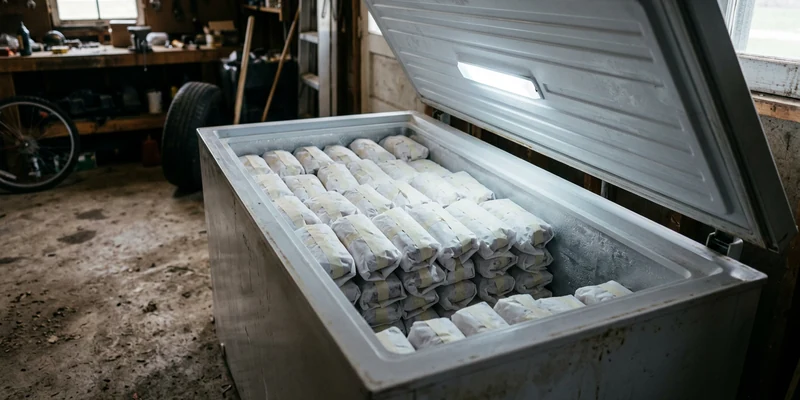
A commonly used rule of thumb is about 1 cubic foot of freezer space for every 25 to 30 pounds of cut and wrapped meat, which means a half share in the 165 to 260 pound range needs roughly 6 to 10 cubic feet. Bone-in cuts and oddly shaped roasts pack less efficiently than uniform packages, so it’s worth rounding up rather than down.
A standalone chest or upright freezer is worth budgeting for if you don’t already have several cubic feet of dedicated space, since a kitchen freezer’s door shelves rarely hold more than a few days’ worth of meat. Our guide to the best chest freezer for meat breaks down the size and feature tradeoffs for exactly this kind of bulk order.

How the beef is packaged changes how much of that space you actually use. Vacuum sealed packages stack flat and waste less room than paper wrapped bundles, so a vacuum sealer effectively buys back part of a cubic foot.

Is Buying Half a Cow Worth It?
Whether a half share makes sense comes down to freezer space, commitment, and how much control you want over the cut list, not just the math on total pounds. It suits a household that already eats beef regularly, has a place to put a dedicated freezer, and wants a say in which roasts and steaks the animal turns into.
It suits a household less well if freezer space is tight, if beef is an occasional purchase rather than a staple, or if the idea of a large volume of ground beef and mixed cuts arriving at once feels like more commitment than it’s worth. Our full buying a half cow guide walks through the ordering process, cut sheet decisions, and what to ask a processor before you commit.
Frequently Asked Questions
How many pounds is half a cow of meat? Roughly 165 to 260 pounds of packaged, take-home meat is typical, based on a half share’s hanging weight of about 275 to 400 pounds and a 60 to 65 percent boneless yield.
How long will half a cow last two people? Commonly six months to a year, depending mostly on how often beef is on the menu rather than the total weight itself.
How many coolers do I need to bring home half a cow? Plan on two to three large coolers, packed as tightly as possible to help the frozen meat stay cold on the drive home.
Is buying half a cow worth it? It depends on your freezer space and how often you eat beef. It works well for a household that eats beef regularly and has room for dedicated freezer storage, and less well for occasional beef eaters or tight kitchens.
What does half a cow cost? Pricing varies widely by region, hanging weight, and how the processor charges for cutting and wrapping, so it’s best treated as a quote you request directly from a local farm or locker rather than a fixed number.
Why is take-home weight so much lower than hanging weight? Boning, trimming excess fat, and moisture loss during aging all reduce the hanging weight, leaving roughly 60 to 65 percent of it as packaged meat.
Do I get to choose my own cuts? Most processors work from a cut sheet you fill out in advance, which lets you choose things like steak thickness, roast sizes, and how much goes toward ground beef versus stew meat.
The Bottom Line
A half beef share typically yields 60 to 65 percent of its hanging weight as packaged meat, split roughly 40 percent ground beef, 20 percent steaks, and 20 percent roasts, with the rest in stew meat and bones. Plan on 6 to 10 cubic feet of freezer space and a firm sense of how often your household actually eats beef before you commit.