Last updated: August 16, 2026
A food dehydrator built for jerky needs to do two things a general kitchen appliance often can’t: hold a steady low temperature for hours, and move enough air across every tray that the whole batch dries at close to the same rate. Buying the wrong one usually shows up as jerky that is leathery on the edges and still damp in the middle.
This guide covers what separates the best dehydrator for jerky from a general food dehydrator, why the thermostat’s top end matters more than people expect, and the tray count, noise, and cleanup differences worth knowing before you buy.
This article contains affiliate links. If you buy through them, we may earn a commission at no extra cost to you.
Quick Answer
What is the best dehydrator for jerky?
- Look for a jerky dehydrator with horizontal, rear-mounted airflow, which dries every tray more evenly than a stacked model with a single bottom or top fan.
- The thermostat should reach at least 160°F, since that lets the machine handle the required pre-heat step for jerky in the unit itself instead of needing a separate oven step.
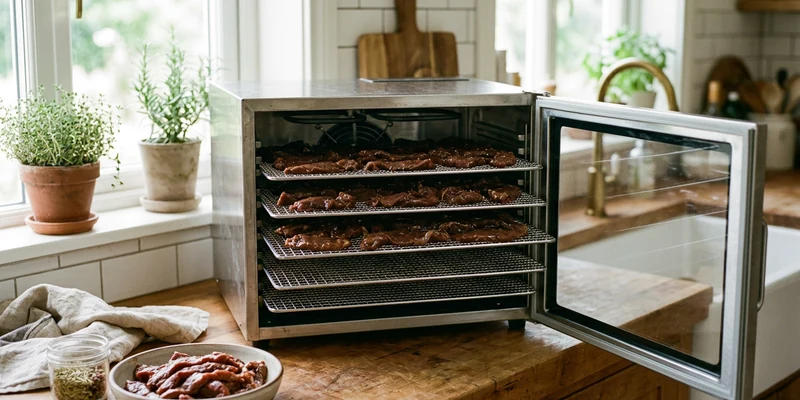
- An excalibur dehydrator is a common pick for serious home processors thanks to its tray count and even horizontal airflow; smaller stacked models work fine for occasional small batches.
- A commercial dehydrator only makes sense once you are processing large volumes regularly; for most home use, a mid-size horizontal-airflow unit covers it.
Horizontal Airflow vs Stacked Trays at a Glance
How a dehydrator moves air across its trays affects both drying evenness and how much you need to rotate trays mid-batch. This table compares the two common designs.
| Design | How air moves | What it means for jerky |
|---|---|---|
| Horizontal airflow | A rear-mounted fan pushes air evenly across every tray at once | More consistent drying tray to tray, little or no rotation needed |
| Stacked, vertical airflow | Air rises from a bottom (or drops from a top) fan through a stack of trays | Bottom or top trays often dry faster than middle ones, so rotation partway through helps |
| Oven with door propped | Uneven, relies on ambient convection | Workable in a pinch but harder to hold a steady low temperature |
Thermostat Range: Why Reaching 160°F Matters
Jerky safety guidance calls for heating meat to an internal temperature of 160°F before drying, and a dehydrator that can actually reach and hold that temperature lets you complete that step in the same machine instead of pre-heating strips in an oven first. Once that pre-heat step is done, drying itself happens at a lower, steady temperature, so the two numbers that matter on a spec sheet are the top of the thermostat’s range and how precisely it holds a low setting for hours at a stretch.
A dehydrator that tops out around 140°F can still make jerky, but only if you handle the pre-heat step separately, which adds a pan and an extra step to the process. Machines that reach 160°F or higher remove that extra step entirely, which is a real convenience difference, not just a spec sheet number.
Our Top Picks at a Glance
How we chose: we compared widely available dehydrators on airflow design, thermostat range, and how consistently owners report even drying across a full load. Selections lean on manufacturer specifications and recurring themes in customer feedback rather than any hands-on trial of our own.
🏆 Best Overall
An excalibur dehydrator with horizontal airflow and a thermostat that reaches 160°F, a common choice for anyone making jerky regularly.

⭐ Upgrade Pick
A larger horizontal-airflow dehydrator with more trays for processing bigger batches after a hunt or a bulk meat order.

💛 Best Value
A stacked-tray dehydrator machine for occasional jerky batches, at a lower cost than a horizontal-airflow unit.

Picks by Situation: Compact and Commercial Volume
Two more situations call for a different dehydrator than the all-purpose picks above.
🏠 Best Compact
A smaller-footprint jerky dehydrator for kitchens with limited counter space, sized for occasional small batches.

🏭 Best for High Volume
A commercial dehydrator built for sustained use and larger loads, the right choice for anyone processing meat regularly at real scale.

Tray Count and Noise
Tray count sets your batch size more than any other single spec. A 4 to 6 tray dehydrator suits occasional small batches, while 9 or more trays let you process a full round of jerky strips or several vegetables and fruits at once without running back-to-back loads.
Fan noise varies more between models than most buyers expect going in, and a dehydrator running for 6 to 10 hours in a kitchen is a real presence in the room. If noise matters to you, checking owner reviews for that specific detail is worth the extra few minutes, since spec sheets rarely mention decibel levels at all.
Uniform slices dry more evenly than hand cut ones, and that gets harder as batch size grows. A meat slicer set to a fixed thickness removes most of the variation that leaves one tray finished and another still tacky.
Cleaning: What Actually Makes a Difference
Trays that are dishwasher safe save real time after a fatty batch, since jerky marinade residue and rendered fat are more stubborn than most dehydrated fruits and vegetables leave behind. Solid trays with a lip, rather than open mesh, also help contain drips before they reach the base and the fan housing.
Wipe down the interior walls and fan housing periodically even if the trays go in the dishwasher, since marinade splatter tends to build up there over repeated jerky batches in a way it doesn’t with lighter dehydrating jobs.
Finished jerky keeps far longer sealed than bagged loose, so a vacuum sealer is a common follow up purchase once someone starts making jerky in real quantities.
Common Mistakes to Avoid
- Buying based on tray count alone. Airflow design affects evenness far more than a few extra trays do.
- Ignoring the thermostat’s top temperature. A unit that can’t reach 160°F means an extra oven step before every jerky batch.
- Skipping tray rotation on a stacked model. Vertical airflow units dry unevenly tray to tray unless you rotate partway through.
- Choosing mesh trays for a fatty marinade. Drips reach the fan housing faster without a lip to contain them.
- Underestimating drying time in a low-cost unit. Weaker fans and less even airflow can add hours to a batch compared to a horizontal-airflow model.
Frequently Asked Questions
What is the best dehydrator for jerky? A jerky dehydrator with horizontal, rear-mounted airflow and a thermostat that reaches at least 160°F handles both the pre-heat step and the drying step evenly, which makes it the strongest general pick.
Is an excalibur dehydrator worth the extra cost? For anyone making jerky regularly, yes. Its horizontal airflow and tray capacity are common reasons it comes up repeatedly in home meat processing comparisons.
Do I need a commercial dehydrator for home jerky making? No, not for typical home volume. A commercial dehydrator only makes sense once you are processing large amounts on a regular, ongoing basis.
Why does the dehydrator’s maximum temperature matter? Jerky safety guidance calls for heating meat to 160°F before drying. A unit that can reach that temperature lets you do the pre-heat step in the machine instead of using a separate oven step.
How many trays do I need for a jerky dehydrator? Four to six trays suit occasional small batches; nine or more trays fit a full round of strips from a larger batch of meat in one load.
Are stacked dehydrators worse than horizontal ones? Not worse, just less even. Stacked, vertical-airflow models dry bottom or top trays faster than middle ones, so rotating trays partway through helps close that gap.
Is dehydrator noise something to worry about? It can be, since a jerky batch often runs 6 to 10 hours. Checking owner reviews for noise complaints is worth the extra step if your kitchen is near a living space.
The Bottom Line
The best dehydrator for jerky combines horizontal, even airflow with a thermostat that reaches at least 160°F, which covers both the required pre-heat step and steady, even drying. An excalibur dehydrator is the common pick for regular home processors; a stacked-tray model is a reasonable lower-cost option for occasional batches.