Last updated: August 16, 2026
Getting curing salt right per pound of meat is one of the few places in home meat processing where a mistake is a genuine safety problem, not just a matter of taste. Too little cure #1 leaves cured meat under-protected against harmful bacteria; too much pushes sodium nitrite past levels that are considered safe.
This guide gives the standard cure #1 ratio as published by a university extension service, explains why you weigh curing salt instead of scooping it, and covers why cure #1 and cure #2 are never interchangeable.
Quick Answer
How much curing salt do you need per pound of meat?
- Oregon State University Extension’s guide to home bacon curing gives the standard cure #1 (Prague Powder #1) ratio as 1 level teaspoon per 5 pounds of meat.
- By weight, that scales to about 1 ounce per 25 pounds, 2 ounces per 50 pounds, and 4 ounces per 100 pounds.
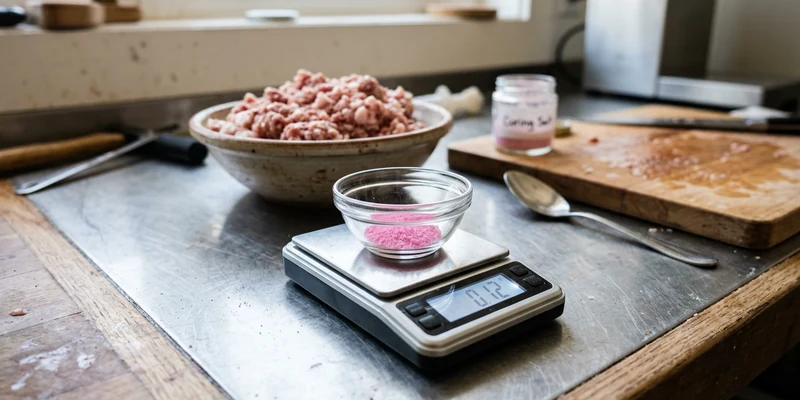
- Weigh curing salt on a kitchen scale rather than measuring by spoon whenever you can, since volume measurements are far less precise than weight.
- Cure #1 and cure #2 are built for different curing timelines and are never interchangeable; when in doubt, always follow the exact ratio printed on your specific product’s packaging.
This is general information rather than personal advice. The ratios below are the published Oregon State University Extension figures rather than our own, and the instructions printed on your specific curing salt always take precedence over a general reference number.
Cure #1 Ratio by Batch Size
These figures come from Oregon State University Extension’s published guide to curing bacon at home, and scale the same 1-teaspoon-per-5-pound ratio up for larger batches.
| Meat weight | Cure #1 amount | Note |
|---|---|---|
| 5 lbs | 1 level teaspoon | The standard reference ratio for home curing |
| 25 lbs | 1 ounce | Weigh on a kitchen scale rather than scaling up teaspoons |
| 50 lbs | 2 ounces | Common batch size for processing a larger cut or bulk order |
| 100 lbs | 4 ounces | Large-batch reference; still weigh rather than estimate |
Source: Oregon State University Extension Service, “Making Cured Bacon at Home” (PNW-784).
The Standard Cure #1 Ratio, and Where It Comes From
According to Oregon State University Extension’s published guide to making cured bacon at home, the standard ratio is 1 level teaspoon of cure #1, also sold as Prague Powder #1 or Instacure #1, per 5 pounds of meat, scaling to 1 ounce per 25 pounds, 2 ounces per 50 pounds, and 4 ounces per 100 pounds. Cure #1 itself is roughly 6.25 percent sodium nitrite, with the remainder food-grade salt.
This ratio is not an arbitrary flavor preference. It is calibrated to deliver enough sodium nitrite to inhibit the growth of Clostridium botulinum, the bacterium behind botulism, while staying well within the federal limits on how much nitrite can go into cured meat.
Why You Weigh Curing Salt Instead of Scooping It
A “level teaspoon” is precise on paper but inconsistent in practice, since how firmly curing salt is packed into a spoon changes the actual weight delivered, and that variation matters far more here than in ordinary cooking. Federal regulations under 9 CFR 424.21 set limits on how much sodium nitrite can go into cured meat products, and the standard cure #1 ratios published by extension services are designed to land comfortably under those limits, but only if the amount used actually matches the amount intended.
A digital kitchen scale removes that guesswork. For anything beyond a very small, single batch, weigh the curing salt against the exact weight of the meat rather than relying on spoon measurements alone, especially once a recipe scales past the reference batch size.

Cure #1 and Cure #2 Are Not Interchangeable
Cure #1 is built for products that will be cooked, smoked, or refrigerated relatively soon, like bacon, ham, and fresh sausage. Cure #2 adds sodium nitrate to that same base, meant for products that dry-cure for weeks or months without cooking, since the nitrate slowly converts to nitrite over that longer timeline. Using one in place of the other either leaves a long dry cure under-protected partway through, or adds nitrate to a quick-cooked product that has no time to use it.
Our full comparison of cure #1 vs. cure #2 covers the composition and use cases for each in more detail, including which one fits typical venison and home sausage projects.
Sausage is where the ratio gets tested most often, because cure has to be distributed evenly through ground meat rather than sitting on a surface. Our sausage stuffer guide covers the equipment side of that.
When the Ratio on Your Package Differs From This
The ratios above are a general reference point, not a substitute for the instructions printed on your specific curing salt product. Manufacturers can vary slightly in concentration or formulation, and their own directions are calibrated to their exact product, so when a package’s instructions differ from a general figure found online or in a book, follow the package.
If a recipe or product’s instructions are unclear or missing entirely, contact the manufacturer directly rather than guessing or averaging figures from different sources. Curing salt is not a place to estimate.
Common Mistakes with Curing Salt Measurements
- Eyeballing the amount instead of weighing it. Curing salt is potent in small quantities, and spoon measurements vary with how tightly the salt is packed.
- Using cure #1 and cure #2 interchangeably. They are built for different curing timelines and neither one substitutes safely for the other.
- Scaling a small-batch ratio up by memory. Recalculate or reweigh for each batch size rather than estimating from a number you remember.
- Ignoring the manufacturer’s printed instructions. General reference ratios are a starting point, not a replacement for your specific product’s directions.
- Storing curing salt near table salt. The two look similar, and mixing them up in either direction is a real safety concern given how different their use rates are.
Frequently Asked Questions
How much curing salt per pound of meat should I use? Oregon State University Extension gives the standard cure #1 ratio as 1 level teaspoon per 5 pounds of meat, scaling to 1 ounce per 25 pounds for larger batches.
What is the cure #1 ratio? The standard reference ratio is 1 level teaspoon of cure #1 per 5 pounds of meat, or 1 ounce per 25 pounds when scaled up and weighed.
What is the Prague powder ratio for sausage? Prague Powder #1 follows the same 1-teaspoon-per-5-pound ratio for sausage that will be cooked or smoked relatively soon, not dry-cured for months.
How much cure #1 should I use for sausage? The same standard ratio applies, 1 level teaspoon per 5 pounds of meat, always weighed and cross-checked against your specific product’s packaging.
Can I use cure #2 instead of cure #1 if that is what I have on hand? No. They are built for different curing timelines, and substituting one for the other either under-protects a long cure or adds unnecessary nitrate to a quick-cooked product.
Why should I weigh curing salt instead of using a measuring spoon? Weight is far more precise than volume for a substance where getting the amount wrong in either direction is a genuine safety issue, not just a quality one.
The Bottom Line
Oregon State University Extension’s published ratio for cure #1 is 1 level teaspoon per 5 pounds of meat, scaling to 1 ounce per 25 pounds and beyond. Weigh it on a kitchen scale rather than scooping, never substitute cure #2 for cure #1 or the reverse, and follow your specific curing salt product’s own packaging whenever it differs from a general reference figure.