Last updated: August 16, 2026
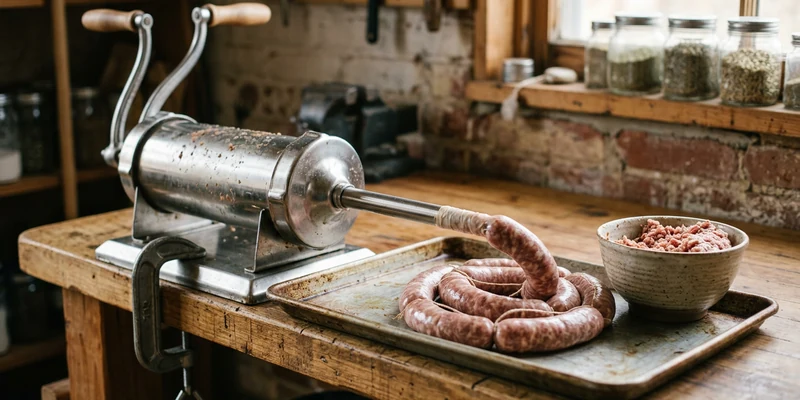
A sausage stuffer is the tool that packs ground, seasoned meat into casings without tearing them or leaving air pockets behind, and it is a different job than grinding. Anyone who has tried to stuff sausage through a grinder’s stuffing horn already knows why a dedicated stuffer earns its own spot on the counter once you make more than a batch or two a year.
This guide covers vertical versus horizontal stuffers, how much capacity you actually need, why gear material matters more than most buyers expect, and what it takes to run one smoothly.
This article contains affiliate links. If you buy through them, we may earn a commission at no extra cost to you.
Quick Answer
Which sausage stuffer should you buy?
- For most home processors, a vertical sausage stuffer with metal gears in the 5 to 15 pound range handles everything from snack sticks to a full batch of venison sausage without straining.
- If you regularly process large volumes, a horizontal, gear-driven stuffer holds more meat per load and needs fewer refills mid-session.
- A manual sausage stuffer is plenty for occasional home use; an electric sausage stuffer only pays off once you are stuffing multiple batches back to back.
- Skip the grinder’s stuffing horn attachment for anything beyond a small test batch, since it grinds and stuffs at the same time and gives you far less control.
Vertical vs Horizontal Stuffers at a Glance
Vertical and horizontal stuffers do the same basic job, pushing meat through a tube into casing, but they handle differently enough that the choice matters. This table lays out the practical differences.
| Feature | Vertical stuffer | Horizontal stuffer |
|---|---|---|
| How it loads | Meat drops into a cylinder from the top; gravity helps compact it | Meat sits in a horizontal piston chamber |
| Typical capacity | Roughly 5 to 30 pounds | Often larger, built for bigger or repeated batches |
| Footprint | Smaller, stands on a counter or clamps to a table edge | Longer and lower, needs more counter or bench space |
| Best for | Most home processors, one deer or a batch of pork sausage at a time | Frequent large batches or processing for more than one household |
| Operator effort | Can be run solo, though a second person still helps | Usually easier with two people managing casing and crank together |
Why a Grinder’s Stuffing Horn Falls Short
A grinder’s stuffing horn attachment grinds and stuffs in the same motion, which sounds efficient but actually removes the control that makes a good sausage. The auger that pushes meat through a grinder head is built for grinding pressure, not the slow, even feed a casing needs, so it tends to force air in along with the meat and can pack some sections tighter than others.
A dedicated sausage stuffer separates the two steps. You grind first with your meat grinder, then load the already-ground, seasoned meat into the stuffer’s cylinder and press it into casing under steady, controllable pressure. That separation is exactly why a stuffing horn is fine for a single test link but frustrating for a full batch of links meant to hold together on the smoker.
Our Top Picks at a Glance
How we chose: we compared widely available stuffers on gear material, cylinder capacity, and how consistently owners report smooth, jam-free operation across repeated stuffing sessions. Selections lean on manufacturer specifications and recurring themes in customer feedback rather than any hands-on trial of our own.
🏆 Best Overall
A vertical sausage stuffer with metal gears and a mid-size cylinder, sized for a typical home processing day without needing constant refills.

⭐ Upgrade Pick
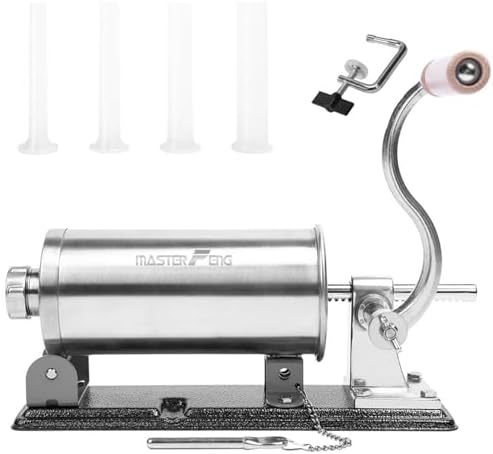
A horizontal, gear-driven stuffer with a larger cylinder for processors who stuff big batches or several sessions in a row.
💛 Best Value
A compact manual sausage stuffer that clamps to a table edge, a solid entry point for a first stuffer without a big investment.

Picks by Situation: Electric and Brand-Name Options
Two more situations call for a slightly different pick than the all-purpose choices above.
⚡ Best Electric
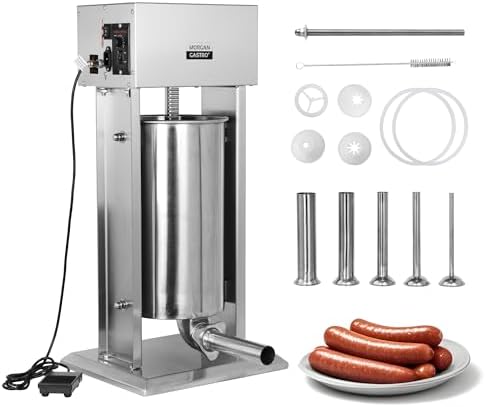
An electric sausage stuffer for anyone running back-to-back batches, since a motor removes the arm fatigue that comes with cranking a large cylinder repeatedly.
🏆 Best From an Established Brand
A LEM sausage stuffer for buyers who want a widely reviewed, established name with easy-to-find replacement parts.

Capacity: How Many Pounds You Actually Need
Match stuffer capacity to your typical batch, not your biggest possible one. A 5 pound stuffer suits someone processing a single deer’s worth of sausage or making small batches for the freezer, while a 15 to 20 pound stuffer fits a household that processes a hog or works through a half cow’s worth of sausage meat in one sitting.
Going bigger than you need mostly costs counter space and cleanup time, since a large cylinder still has to be filled, run, and washed whether you use its full capacity or not. If you are processing in bulk after buying a half cow, a stuffer in the 15 pound-plus range will save you from reloading the cylinder repeatedly mid-session.
Most of what comes off a stuffer goes into a smoker next, so batch size and rack space are worth matching. Our smoker guide covers capacity by rack rather than by exterior size.
Metal Gears vs Plastic Gears
Gear material is one of the biggest differences between a stuffer that lasts for years and one that fails within a season. Plastic gears flex and wear under the steady resistance of dense, cold meat, and once teeth start stripping, the stuffer either binds up mid-batch or stops advancing the piston at all.
Metal gears, usually cast or machined steel, hold up to that same resistance without deforming, which is why most stuffers built for repeated use feature them. A dual-gear system, offering a slower high-torque speed for pushing meat and a faster speed for retracting the piston, is a genuine convenience worth checking for, since the retraction step happens every single time you refill the cylinder.
Stuffed sausage still has to reach a safe internal temperature before it comes off, which is a probe job rather than a timing job. The thermometer comparison covers leave in probes against instant read models.
Operating a Stuffer: Why Two People Make It Easier
Stuffing sausage solo is possible, especially with a smaller vertical stuffer that clamps in place, but two people make the process noticeably smoother. One person cranks or runs the motor at a steady pace while the other guides the casing off the tube and controls how tightly it fills, watching for the twists and pinches that come at the end of each link.
Trying to do both jobs alone tends to produce uneven links, since it is hard to control feed speed and casing tension with the same set of hands. If you only ever stuff solo, slow the pace down and keep one hand lightly cupped around the casing as it fills rather than letting it feed unattended.
Common Mistakes to Avoid
- Using a grinder’s stuffing horn for a full batch. It works for a test link but tends to trap air and pack meat unevenly across a whole batch.
- Choosing plastic gears to save money upfront. Stripped gears are one of the most common reasons cheap stuffers fail within a season.
- Overfilling casings under high pressure. Casings split when they are packed too tight, especially natural casings that have not been soaked long enough first.
- Skipping the second pair of hands. Solo stuffing works, but uneven links are far more common without someone managing the casing.
- Buying capacity you never use. A stuffer far larger than your typical batch mostly adds cleaning time and storage bulk.
Frequently Asked Questions
Do I really need a separate sausage stuffer, or can I use my grinder? A grinder’s stuffing horn works for a small test batch, but a dedicated stuffer gives far more control over feed speed and pressure, which matters once you are stuffing a full batch of links.
How do you use a sausage stuffer? Load pre-ground, seasoned meat into the cylinder, slide soaked casing onto the stuffing tube, and crank or run the motor at a steady pace while a second person guides the casing off the tube and manages tension.
Is a vertical or horizontal sausage stuffer better? Vertical stuffers suit most home processors with their smaller footprint and gravity-assisted loading. Horizontal stuffers hold more and work better for large, repeated batches.
What size sausage stuffer do I need? A 5 pound stuffer covers a single deer or small batches; 15 to 20 pounds fits a household processing a hog or a half cow’s worth of sausage meat at once.
Are metal gears worth paying more for? Yes. Plastic gears strip out under the resistance of dense, cold meat far sooner than metal gears do, which is one of the most common reasons budget stuffers fail early.
Can one person operate a sausage stuffer alone? Yes, particularly with a smaller vertical model, though a second person managing the casing produces more even links than working solo.
What is a LEM sausage stuffer known for? LEM is an established brand in home meat processing equipment, and its stuffers are widely reviewed with easy-to-find replacement parts and casings.
The Bottom Line
Most home processors do best with a vertical sausage stuffer that has metal gears and a cylinder sized to their typical batch, stepping up to a horizontal model only if batches are large or frequent. Skip the grinder’s stuffing horn beyond a test link, and bring a second pair of hands when you can, since that alone fixes most of the uneven links people blame on the equipment.