Last updated: August 16, 2026
Vacuum seal bags are not one universal product, even though most people shop for them that way. A bag built for a countertop suction sealer and a bag built for a chamber machine are made differently, sold in different formats, and are not always interchangeable, and buying the wrong one is the most common reason a new vacuum sealer seems to “not work right.”
This guide covers the two main bag styles and why they are not interchangeable, rolls versus pre cut bags, what mil thickness actually means for meat, using bags for cooking and sous vide, and whether you can safely reuse a bag.
Quick Answer
What are the best vacuum seal bags for meat?
- Match the bag to the machine: embossed, channeled bags for suction sealers, smooth bags for chamber sealers. They are not interchangeable.
- For bulk processing, rolls let you size each bag to the cut and waste less material than pre cut bags.
- For sous vide, use bags labeled safe for boiling or the specific cook temperature you plan to use.
- Reuse is fine for dry, non raw meat contents after washing; skip reuse for anything that held raw meat or liquid.
Vacuum Seal Bag Types Compared
Vacuum seal bags fall into a handful of practical categories, and the right one depends on your machine and how you process meat. This table lines up the main options side by side.
| Bag Type | Works With | Best For |
|---|---|---|
| Embossed (channeled) bags | External suction sealers | Everyday home use, portioning cuts as you butcher |
| Smooth chamber bags | Chamber vacuum sealers | Bulk processing, liquid marinades, high volume households |
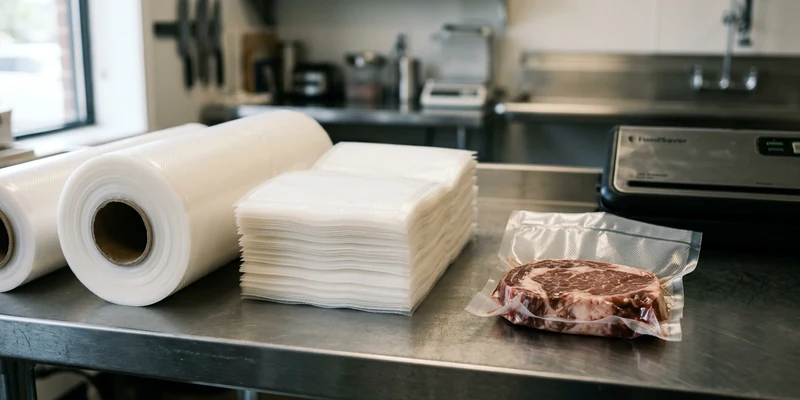
| Vacuum sealer rolls | Either machine, cut to size | Odd shaped cuts, custom lengths, less wasted material |
| Pre cut bags | Either machine, fixed sizes | Uniform portions like steaks, chops, or ground meat packs |
Why Embossed and Chamber Bags Are Not Interchangeable
Embossed bags have a dimpled, textured surface that creates tiny air channels the machine needs to pull air out from between the bag and the food. Chamber bags are smooth because the entire chamber around the bag is evacuated at once, so no internal air channel is needed. Put a smooth bag in a suction sealer and it often will not seal properly, because there is no channel left for air to escape through as the edges seal shut.
The reverse mismatch is not a failure so much as a waste of money: a chamber machine does not need the thicker, more expensive embossed material to pull a full vacuum, so using embossed bags in a chamber sealer just costs more per bag for no benefit.

Rolls vs Pre Cut Bags: Which Wastes Less
Rolls make sense for anyone processing whole or half animals, since a home processed cut rarely matches a standard bag size and a roll lets you cut each bag to the exact length the piece needs. Pre cut bags make sense when the output is uniform, like steaks, chops, or one pound packs of ground meat, where the time saved by not measuring and sealing an extra end outweighs the bit of wasted material on odd shaped pieces.
A practical approach many home processors land on is keeping a roll on hand for irregular cuts like roasts or whole loins, and a stack of pre cut bags in one or two common sizes for everything that comes out uniform.
Bag Thickness in Mil: What It Actually Changes
Mil thickness measures how much puncture resistance a bag has, and it matters most when the contents have sharp edges. Standard embossed bags for suction sealers typically run in the range most home machines are designed for, while chamber bags are commonly available in a lighter option for everyday food and a heavier option built for tougher jobs.
When to size up
Bone in cuts, whole ribs, and anything with a sharp trimmed edge are the situations where a thin bag fails at the seam within days, even in a properly working freezer. Choosing a heavier bag for those cuts, or wrapping a sharp bone tip in a scrap of freezer paper before sealing, prevents the slow leak that lets air back in and defeats the point of vacuum sealing in the first place.

Thickness buys you less if the freezer itself swings in temperature. A steady chest freezer does more for a two year package than an extra mil of bag does.
Using Vacuum Seal Bags for Cooking and Sous Vide
Not every vacuum bag is rated for direct contact with boiling or near boiling water, so check the packaging before using a bag for sous vide rather than assuming any vacuum bag will do. Bags labeled food grade and safe for boiling or for the specific sous vide temperature range you plan to cook at are built to hold their seal and avoid leaching under sustained heat, which standard freezer only bags are not always tested for.
If sous vide is a regular part of how you cook what you process, it is worth pairing bag choice with the sealer itself. Our guide to the best vacuum sealer for meat covers which machines handle both freezer sealing and sous vide bagging well.
Can You Reuse Vacuum Sealer Bags?
Reusing a vacuum bag is reasonable for dry contents, like a bag that held frozen vegetables or dry cured jerky, as long as it is washed, fully dried, and shows no punctures. Reuse is not a good idea for any bag that held raw meat or a liquid marinade, since raw meat residue is difficult to fully clean out of the corners and seams, and a bag that has already stretched around a liquid seal loses reliability the second time.
If the goal is cutting down on waste rather than saving a few bags, buying a roll and sizing bags precisely to the cut wastes far less material over a season of processing than trying to stretch the life of bags that held raw meat.

How long a sealed package actually holds up depends on storage as much as on bag choice, which our guide to deep freezers works through by format.
Common Mistakes When Buying Vacuum Seal Bags
- Buying smooth bags for an external suction sealer. Without embossed channels, the machine often cannot pull a full vacuum before the seal closes.
- Assuming every bag is sous vide safe. Check the label for a boiling or cooking temperature rating before using a bag in a water bath.
- Sealing bone in or sharp trimmed cuts in standard thickness bags. A small puncture at the seam lets air back in within days, not months.
- Reusing bags that held raw meat. Residue in the seams is hard to fully clean and creates a real contamination risk on the next use.
- Buying only pre cut bags for whole animal processing. Odd shaped cuts waste far more bag material than a roll sized to the piece.
Frequently Asked Questions
Are vacuum sealer bags universal? No. Embossed, channeled bags are made for external suction sealers, and smooth bags are made for chamber sealers. Using the wrong style for your machine often prevents a proper seal.
Can you reuse vacuum sealer bags? Yes, for dry contents that did not involve raw meat or liquid, as long as the bag is washed, fully dried, and undamaged. Skip reuse after raw meat.
What mil bag should I use for meat? Standard thickness works for boneless cuts and ground meat. Choose a heavier bag, or pad sharp edges, for bone in cuts and whole ribs.
Are vacuum sealer bags safe for sous vide? Only bags labeled food grade and rated for boiling or your target cook temperature. Not every vacuum bag is built for sustained heat exposure.
Should I buy rolls or pre cut bags? Rolls waste less material on odd shaped or bulk cuts. Pre cut bags are faster for uniform portions like steaks or one pound packs of ground meat.
Do all vacuum sealer bags work in every machine? No. Check whether your sealer is an external suction model or a chamber model before buying, since the two use different bag styles.
Why did my vacuum bag not seal properly? A mismatched bag style is the most common cause, along with moisture, folds, or bone fragments caught in the seal area.
The Bottom Line
Vacuum seal bags are not one size fits all: match embossed bags to suction sealers and smooth bags to chamber sealers, choose rolls for odd cuts and pre cut bags for uniform ones, size up in thickness for bone in meat, confirm a sous vide rating before boiling, and skip reuse after raw meat.