Last updated: August 16, 2026
Knowing how to clean and sharpen a meat slicer is not just a matter of keeping the machine looking nice. A slicer blade sits in direct contact with raw meat, over and over, and a dull or dirty one is both a food safety problem and a reason for uneven, torn slices.
This guide covers how often a slicer actually needs cleaning depending on how you use it, how to take one apart safely, how the built-in sharpening stone works, and when a blade has worn past the point where sharpening still helps.
Quick Answer
How often should you clean and sharpen a meat slicer?
- Clean a home slicer immediately after every session, and always before switching between raw and ready-to-eat food.
- During continuous or extended use, the FDA Food Code standard that food safety extension programs also point to calls for a full disassembly, clean, and sanitize at least every four hours.
- Use the slicer’s built-in sharpening stone every several uses, or as soon as slices start tearing instead of cutting cleanly.
- Replace the blade rather than keep sharpening once repeated honing no longer restores a clean edge.
Cleaning Frequency at a Glance
How often a slicer needs cleaning depends much more on the pattern of use than on the calendar.
| Use pattern | Cleaning frequency | Why |
|---|---|---|
| Occasional home use | Immediately after every session | Residue dries and hardens quickly, and a slicer that sits dirty between rare uses is more likely to be skipped entirely |
| Regular weekly home use | After every session, full disassembly at least weekly | Buildup in hard-to-reach spots accumulates even when the visible surface looks clean |
| Continuous or extended sessions | At least every four hours, per FDA Food Code guidance | Bacteria like Listeria can establish on food-contact surfaces during long stretches of ongoing slicing |
| Switching between raw and ready-to-eat food | Before every switch, not just at the end | Prevents cross-contaminating cooked or ready-to-eat items with anything from raw meat |
Why Slicers Need Frequent Cleaning
A slicer blade and carriage have a lot of surface area in direct, repeated contact with raw meat, which makes them one of the higher-risk pieces of equipment in any kitchen that processes meat regularly. The FDA Food Code, a standard that university food safety extension programs like the University of Minnesota Extension also reference in their own guidance on sanitizing food-contact equipment, calls for cleaning and sanitizing a slicer at least every four hours during continuous use, specifically because of the risk of Listeria monocytogenes establishing itself on slicer surfaces over time.
For home use, that four-hour benchmark mostly matters if you are running the slicer continuously through a large batch, a bulk order of deli meat, or a big processing day. For a typical single session, cleaning immediately afterward, rather than leaving the slicer to sit, covers the same underlying risk.
How to Take a Slicer Apart for Cleaning
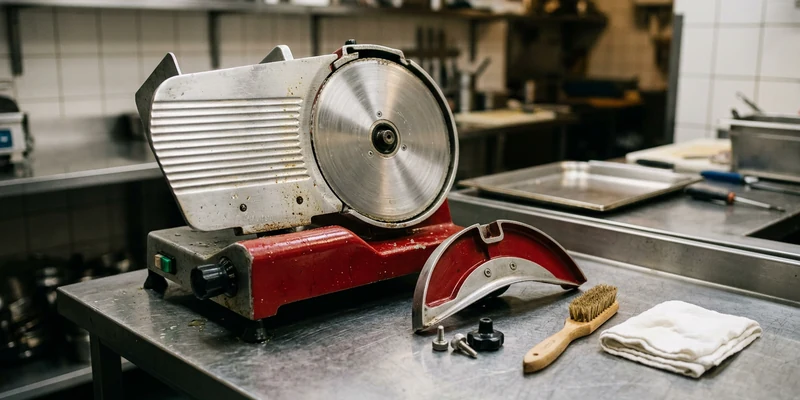
Unplug the slicer before doing anything else, since reaching near a blade that could still be powered on is one of the most avoidable ways slicers cause injuries. Set the thickness dial to zero to close the gap around the blade, then remove the blade guard, ring guard, and any removable parts according to the manufacturer’s instructions, most machines are designed for tool-free or minimal-tool disassembly specifically so this step does not get skipped.
Washing and sanitizing
Hand wash the blade, carriage, and removable parts in warm, soapy water rather than running them through a dishwasher, unless the manufacturer specifically says the parts are dishwasher-safe. Rinse thoroughly, then sanitize; the University of Minnesota Extension’s guidance on sanitizing food-contact surfaces points to chlorine solutions of roughly 100 to 200 parts per million, or iodine solutions of 12 to 25 parts per million, with at least 30 seconds of contact time on the surface.
Let everything air dry completely before reassembling, since trapped moisture on a metal blade invites both rust and bacterial growth. Wipe down the base, motor housing, and any area the blade guard does not fully expose with a damp cloth, since food particles and juices travel further across a slicer’s surface than most people expect during normal use.
Slicing wild game and poultry
Raw wild game and raw poultry both carry a higher baseline risk of surface bacteria than a store-bought roast, so treat cleaning as non-negotiable after slicing either one, not just recommended. If a session includes both venison and something ready-to-eat, like cooked jerky for testing thickness, clean and sanitize the slicer between the two rather than waiting until the end of the whole session.
Using the Built-In Sharpening Stone
Most home and semi-commercial slicers include a built-in sharpening stone or stone assembly mounted near the blade, designed to hone the edge without removing the blade from the machine. Run the stone assembly according to the manufacturer’s instructions, typically a short cycle with light pressure, and check the result on a test slice before assuming the job is done.
Use the built-in stone every several uses for a regularly used slicer, or as soon as you notice slices tearing or requiring extra pressure to cut cleanly, rather than waiting for a fixed schedule. A blade that is cutting well does not need sharpening just because time has passed.
When a Blade Needs Replacing, Not Just Sharpening
A blade that no longer holds an edge after repeated honing on the built-in stone, or one that shows visible nicks, chips, or an uneven edge along its length, has reached the point where sharpening stops helping. Continuing to slice with a worn-out blade means more pressure needed to cut, which increases the chance of the meat slipping or the operator’s hand moving closer to the blade than intended.
Replacement blades are sized and shaped specifically for each slicer model, so match the exact model when ordering rather than assuming a similar-looking blade will fit properly.

Common Mistakes to Avoid
- Leaving the slicer dirty “until next time.” Dried residue is harder to remove and gives bacteria more time to establish.
- Running removable parts through a dishwasher without checking. Not all slicer components are dishwasher-safe, and heat or harsh detergent can warp some parts.
- Reaching near the blade without unplugging first. This is one of the most preventable causes of slicer injuries during cleaning.
- Sharpening on a fixed schedule instead of by feel. A blade that is still cutting cleanly does not need honing just because a set amount of time has passed.
- Continuing to slice with a chipped or nicked blade. A damaged edge needs replacement, not more time on the sharpening stone.
Frequently Asked Questions
How often should a meat slicer be cleaned? Immediately after every home session, and at least every four hours during continuous or extended use, per FDA Food Code guidance.
How do you sharpen a meat slicer blade? Most slicers include a built-in sharpening stone assembly that hones the blade in place; run it according to the manufacturer’s instructions and check the cut on a test slice afterward.
What are meat slicer blades made of? Most are stainless steel, chosen for its resistance to rust and corrosion from repeated contact with raw meat and moisture.
How do I know a meat slicer blade needs replacing? If honing no longer restores a clean edge, or the blade shows visible nicks, chips, or unevenness, it is time to replace it rather than keep sharpening.
Can I put slicer parts in the dishwasher? Only if the manufacturer specifically states the parts are dishwasher-safe. Otherwise, hand wash, sanitize, and air dry completely.
Why does a meat slicer need cleaning between raw and cooked food? To prevent cross-contamination; a slicer used on raw meat and then, unwashed, on ready-to-eat food can transfer bacteria from one to the other.
The Bottom Line
Clean a home slicer after every session and disassemble it fully at least weekly, or every four hours during continuous use, following the same standard the FDA Food Code and extension food safety programs point to. Hone the blade on the built-in stone when slices start tearing, and replace the blade entirely once honing no longer restores a clean edge.
See cleaning frequency at a glance