Last updated: August 16, 2026
Hitting a safe internal temperature is the only reliable way to know meat has reached a point where harmful bacteria are killed, and it is not the same number for every type of meat. USDA’s Food Safety and Inspection Service (FSIS) publishes specific minimums for whole cuts, ground meat, and poultry, and the differences between them are not arbitrary.
This guide lays out the FSIS safe minimum internal temperatures by meat type, including rest time, explains why color is not a reliable safety check, and covers where to actually place a thermometer to get an accurate reading.
Quick Answer
What is a safe internal temperature for meat?
- Whole cuts of beef, pork, veal, and lamb, steaks, roasts, and chops, need 145 degrees Fahrenheit with a 3-minute rest, per USDA FSIS.
- Ground meats, including beef, pork, veal, lamb, and wild game, need a higher 160 degrees Fahrenheit, with no rest time required.
- All poultry, whole or ground, needs 165 degrees Fahrenheit.
- Color is not a reliable safety indicator; always confirm with a food thermometer inserted into the thickest part of the meat.
This is general information rather than personal advice. Every temperature below is a published USDA figure rather than our own recommendation, and what it is worth depends on your thermometer being accurate and placed correctly, which the sections further down cover.
USDA Safe Minimum Internal Temperatures
These figures come from USDA FSIS’s Safe Minimum Internal Temperature Chart, the reference standard for cooking meat, poultry, and eggs to a safe temperature.
| Meat or food type | Minimum internal temperature | Rest time |
|---|---|---|
| Beef, pork, veal, lamb (steaks, roasts, chops) | 145°F | 3 minutes |
| Ground meats (beef, pork, veal, lamb) | 160°F | None required |
| Fresh or wild game, whole cuts (deer, elk, and similar) | 145°F | 3 minutes |
| Ground wild game | 160°F | None required |
| All poultry, whole and ground | 165°F | None required |
| Egg dishes | 160°F | None required |
| Leftovers and reheated food | 165°F | None required |
Source: USDA Food Safety and Inspection Service (FSIS), Safe Minimum Internal Temperature Chart.
Why These Numbers Matter: Killing Bacteria, Not Just Cooking
Each of these temperatures reflects the point at which harmful bacteria, including Salmonella and E. coli, are reliably killed in that specific type of meat, according to USDA FSIS guidance. The temperature is not a doneness preference; it is the threshold FSIS has determined is necessary for safety, which is why the agency is direct that color, texture, or how long something has cooked are not substitutes for an actual reading.
Ground meat needs a higher temperature than whole cuts specifically because grinding spreads any bacteria present on the original meat’s surface throughout the entire batch, rather than leaving it confined to the exterior, where cooking heat reaches fastest and most reliably.
Why Color Is Not a Reliable Safety Indicator
Meat can turn brown well before it reaches a safe internal temperature, and it can also stay pink after it has already passed one, depending on factors like the animal’s age, the cut, added ingredients, or even altitude, none of which have anything to do with bacterial safety. USDA guidance is explicit that a food thermometer, not visual appearance, is the only reliable way to confirm meat has reached its safe minimum temperature.
This matters especially for ground meat and for wild game, where variability in color is common and easy to misread in either direction. A meat thermometer removes the guesswork entirely.
Where to Actually Insert the Thermometer
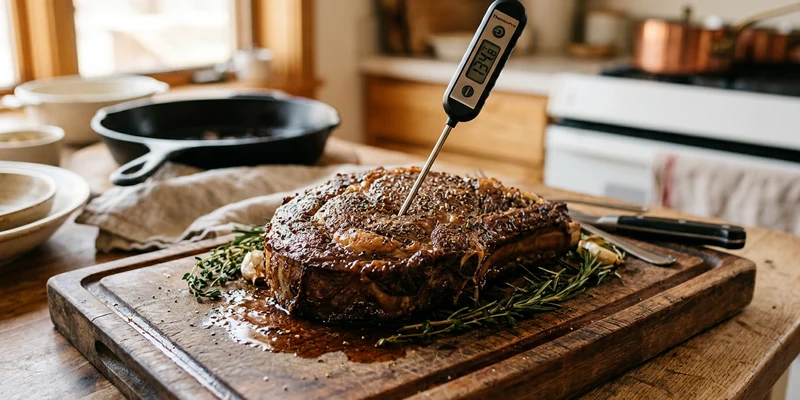
Insert the thermometer probe into the thickest part of the meat, away from bone, fat, and gristle, since those areas heat differently than muscle and can give a falsely high or low reading. For irregularly shaped cuts, like a roast or a whole bird, check more than one spot, since thickness and heat penetration are rarely uniform across the entire piece.
For thin cuts, insert the probe from the side so the tip sits at the center of the thickness rather than passing all the way through, which is the only way to get an accurate reading on something too thin to probe from the top.

Ground Meat and Wild Game Need Extra Care
Ground meat’s higher 160 degree threshold exists because grinding mixes surface bacteria throughout the batch, so the entire volume needs to reach a temperature that would only be necessary at the exterior of a whole cut. This applies just as much to ground venison and other ground wild game as it does to ground beef or pork.
Field-dressing conditions add another layer of variability for hunters, since time, temperature, and handling in the field affect how meat should be handled well before it reaches a stove or smoker. Our guide on deer processing after the hunt covers that earlier stage of the process.
The 3-Minute Rest Time, and When It Doesn’t Apply
The 3-minute rest time applies to whole cuts of beef, pork, veal, and lamb, including wild game steaks and roasts, and it matters because the temperature continues to rise slightly and hold during that rest, which is part of how USDA calculated the 145 degree threshold as sufficient. Skipping the rest and cutting into the meat immediately after it hits 145 degrees does not deliver the same safety margin as the full guidance intends.
Ground meats, poultry, and reheated leftovers do not have a rest-time requirement in FSIS guidance; those temperatures are considered sufficient at the moment they are reached, without an additional hold.
Common Mistakes to Avoid
- Judging doneness by color alone. Meat can look done before it is safe, or stay pink after it already is, for reasons unrelated to bacterial safety.
- Skipping the 3-minute rest on whole cuts. The rest time is part of how the 145 degree threshold was determined to be safe.
- Inserting the thermometer near bone or fat. This can give a misleadingly high or low reading compared to the actual meat temperature.
- Using the same 145 degree target for ground meat. Grinding spreads surface bacteria throughout the batch, which is why ground meat needs 160 degrees.
- Checking only one spot on an irregular cut. Thickness varies across a roast or whole bird, so one reading may not reflect the coldest point.
Frequently Asked Questions
What temperature kills bacteria in meat? The safe minimum varies by meat type: 145°F for whole cuts of beef, pork, veal, and lamb with a 3-minute rest, 160°F for ground meats, and 165°F for all poultry, per USDA FSIS.
What is a safe internal temperature for beef? Whole cuts, steaks and roasts, need 145°F with a 3-minute rest. Ground beef needs a higher 160°F, with no rest time required.
Do I need to rest meat after cooking it to a safe temperature? Yes, for whole cuts of beef, pork, veal, and lamb; a 3-minute rest after reaching 145°F is part of USDA’s safety guidance. Ground meats and poultry do not have this requirement.
Is pink meat always unsafe? Not necessarily, and the reverse is also true: brown meat is not automatically safe. Color depends on several factors unrelated to bacterial safety, so a thermometer reading is the only reliable check.
What temperature should ground meat reach? 160°F, higher than the 145°F target for whole cuts, since grinding spreads any surface bacteria throughout the entire batch.
What temperature should chicken and other poultry reach? 165°F for all poultry, whether whole, in pieces, or ground, with no additional rest time required.
Do I really need a meat thermometer, or can I check by looking? A thermometer is necessary. USDA guidance is explicit that appearance, texture, and cooking time are not reliable substitutes for an actual temperature reading.
The Bottom Line
Safe internal temperatures vary by meat type, 145°F with a 3-minute rest for whole cuts of beef, pork, veal, and lamb, 160°F for ground meats, and 165°F for all poultry, per USDA FSIS. Color is not a reliable indicator either way, so always confirm with a thermometer in the thickest part of the meat, away from bone and fat.
See the full temperature chart