Last updated: August 16, 2026
Canning meat at home is safe only when it’s done in a pressure canner, and this is one of the few rules in home food preservation with no acceptable workaround. Meat is a low-acid food, and low-acid foods processed any other way can harbor the bacterium that causes botulism without showing any obvious sign of spoilage.
This guide explains why pressure canning is the only safe method for meat, how a pressure canner actually differs from a stovetop pressure cooker, what destroys botulism risk, and how to recognize when a can or jar isn’t safe to eat.
Quick Answer
Is It Safe to Can Meat at Home?
- Yes, but only in a pressure canner. Meat is a low-acid food and the USDA and National Center for Home Food Preservation (NCHFP) recommend pressure canning as the only safe method.
- A boiling water bath canner never gets hot enough to destroy the spores that cause botulism in low-acid food.
- A stovetop pressure cooker is not the same tool as a pressure canner, and USDA guidance does not recommend using one for canning.
- For the exact processing time and pressure for your jar size and altitude, use the current USDA Complete Guide to Home Canning or the NCHFP website rather than a general estimate.
This is general information rather than personal advice. Home canning of meat is one area where the tested USDA processes exist for a reason, so treat those and your canner manufacturer instructions as the authority rather than any recipe found online, this article included.
Is Your Canning Method Actually Safe for Meat?
Not every canner on the market, or in a kitchen cabinet, is built or tested for canning low-acid food safely. This table sorts out which methods USDA guidance actually recommends for meat.
| Method | Safe for canning meat? | Why |
|---|---|---|
| Pressure canner (dial or weighted gauge) | Yes, the only recommended method | Reaches roughly 240°F (116°C), hot enough to destroy botulism spores, per USDA and NCHFP guidance |
| Boiling water bath canner | No, never for meat | Tops out around 212°F (100°C), not hot enough to destroy botulism spores in a low-acid food |
| Stovetop pressure cooker (small, under about 4 quarts) | No | Not designed or tested for canning; USDA guidance specifically advises against it |
| Electric multi-cooker with a “canning” setting | No | Not USDA-tested or approved for home canning, according to NCHFP |
Why Meat Must Be Pressure Canned, Never Water-Bathed
Meat is a low-acid food, meaning it doesn’t have enough natural acidity to stop the bacterium Clostridium botulinum from growing inside a sealed jar. According to the National Center for Home Food Preservation, low-acid foods must be processed in a pressure canner because that’s the only home method that reaches the roughly 240°F needed to destroy botulinum spores; a boiling water bath, even a long one, never exceeds the boiling point of water and simply isn’t hot enough to do the job.
This matters because Clostridium botulinum spores can survive in a sealed, low-acid jar that was never pressure canned, and if conditions inside that jar let them grow, they produce a toxin that can be fatal in very small amounts. The danger is that an improperly canned jar of meat can look, smell, and taste completely normal, which is exactly why the rule is pressure canning only, with no exceptions for meat, poultry, or other low-acid foods.
Pressure Canner vs. Pressure Cooker: Not the Same Tool
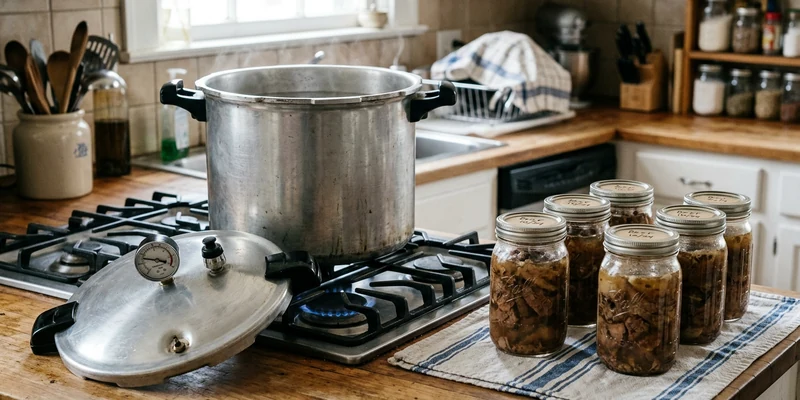
A pressure canner is a large, heavy pot, often big enough to hold seven quart jars, that’s specifically designed and tested for the extended, controlled processing home canning requires. A stovetop pressure cooker is a smaller cooking pot, generally four quarts or less, built to speed up everyday cooking rather than to hold a precise pressure for a precise, tested length of time.
Why the Size and Design Difference Is a Safety Issue
USDA processing times and pressures were developed using full-size pressure canners, which heat up and cool down more slowly than a small pressure cooker. A smaller pressure cooker changes how long the food is actually exposed to high heat, and many pressure cookers also lack a reliable way to confirm the pressure being held inside, which means there’s no way to verify the food received enough heat to destroy botulinum spores. That’s why USDA guidance does not recommend pressure cookers, or electric multi-cookers with a canning function, as a substitute for a true pressure canner.
That distinction is a purchase decision as much as a technique one, since an electric multicooker with a canning button is not a tested pressure canner. The published USDA processes assume a canner rated and tested for the pressures they call for.

What Actually Destroys Botulism Risk
Destroying botulinum spores in canned meat depends on the combination of temperature, pressure, and time all being correct together, not any single one of those factors on its own. Change any part of that combination, a shorter processing time, a lower pressure, a larger jar, and the guidance built around it no longer applies.
Several things shift what your own canner needs to do: your altitude changes the pressure or time required, quart jars generally need more processing time than pints, and whether the meat is raw-packed or hot-packed changes the number as well. Because getting any one of these wrong undermines the whole safety margin, look up the exact time and pressure for your specific jar size, pack style, and altitude in the current USDA Complete Guide to Home Canning or on the National Center for Home Food Preservation’s website rather than relying on a memorized number or an old family recipe card.
Botulism From Dented Cans: A Different Risk, Same Organism
Concerns about dented cans usually involve commercially canned food from the grocery store, which is a different risk picture than home canning, though the underlying organism of concern is the same. According to USDA guidance, a can with a small, shallow dent is generally still safe if the seams are undamaged, but a can with a deep dent, one you can lay a finger into, or any dent along a seam or the rim should be discarded rather than used.
A dent itself doesn’t cause botulism, but a dent that damages a can’s seam can let bacteria in, which is why the seam, not the dent’s size alone, is what actually matters. Never use a can, home canned or store bought, that’s leaking, bulging, or spurts liquid when opened, since those are classic warning signs of contamination.
Signs a Jar of Home-Canned Meat Isn’t Safe
A bulging or loose lid, liquid that spurts out when the jar is opened, cloudy liquid that should be clear, a foul odor, or any sign of mold are all reasons to discard a jar of home-canned meat without tasting it. Botulinum toxin can be present without any of these obvious signs, but when a warning sign is present, it is not worth testing your luck to find out.
USDA and CDC guidance is consistent on this point: if you have any doubt about a jar’s safety, discard it without tasting, and dispose of it in a way that keeps people and animals from accidentally consuming it. No amount of reheating or boiling at home should be treated as a reliable way to salvage a jar you’re unsure about.
Freezing sidesteps the botulism question entirely for anyone not set on canning, and for bulk meat it is usually the cheaper route as well. Our deep freezer guide covers sizing.
Frequently Asked Questions
Can you can meat in a water bath canner? No. Meat is a low-acid food and a boiling water bath never gets hot enough to destroy the spores that cause botulism. USDA and NCHFP guidance requires a pressure canner for meat.
What’s the difference between a pressure canner and a pressure cooker? A pressure canner is a larger, heavier pot specifically designed and tested for home canning. A stovetop pressure cooker is a smaller everyday cooking tool that USDA guidance does not recommend as a substitute for canning.
Can you use an electric pressure cooker’s canning button to can meat? No. Electric multi-cookers with a canning setting are not USDA-tested or approved for home canning, according to the National Center for Home Food Preservation.
What causes botulism in canned meat? The bacterium Clostridium botulinum can survive and grow in a sealed, low-acid jar that wasn’t processed at a high enough temperature for long enough, which only a properly used pressure canner reliably achieves.
Is it safe to eat food from a dented can? A small, shallow dent away from the seams is generally considered safe. A deep dent, or any dent on a seam or rim, means the can should be discarded, per USDA guidance.
Where can I find the exact processing time and pressure for canning meat? The current USDA Complete Guide to Home Canning and the National Center for Home Food Preservation’s website provide tested times and pressures by jar size, pack style, and altitude. Use those directly rather than a general estimate.
What should I do if a home-canned jar’s lid is bulging? Discard the jar without tasting it and dispose of it so it can’t be eaten by accident. A bulging lid is one of the classic warning signs of unsafe canned food.
The Bottom Line
Canning meat at home is safe only in a pressure canner, never a water bath canner or a stovetop pressure cooker, because meat is a low-acid food and only pressure canning reaches the temperature needed to destroy botulism spores. Look up the exact time and pressure for your jar size and altitude from USDA or the National Center for Home Food Preservation, and discard without tasting any jar or can that shows warning signs.
See which methods are actually safe